
Documentation
Infrastructure you can hand over to another team
SafeCore pays particular attention to quality engineering documentation, which is the foundation of stable, manageable IT infrastructure. All documentation is produced in line with the client’s technical requirements and modern engineering practice — so it stays usable no matter who maintains the system next.

-
 10
types of document
prepared by SafeCore
10
types of document
prepared by SafeCore
-
 5
documentation groups
from architecture to procedures
5
documentation groups
from architecture to procedures
-
 4
of 8 stages
where documenting sits in the SafeCore approach
4
of 8 stages
where documenting sits in the SafeCore approach
-
 4
steps
from input data to handover
4
steps
from input data to handover
Service scope
Which documents SafeCore prepares
The set is shaped around the specific system: some documents are prepared before the work, others from its results.
-

Architecture documentation
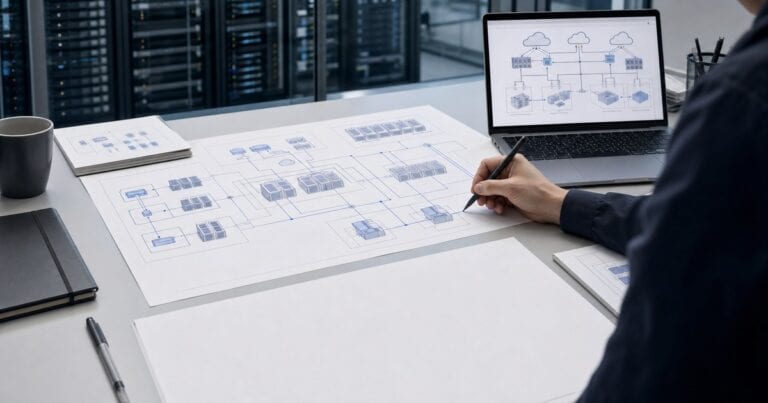
HLD, LLD and network interaction diagrams — a description of how the system is built and why it is built that way.
-

Design documentation
Technical designs and working documents — the set the system is built from.
-

As-built documentation
A description of what was actually installed and configured, taking account of changes made during the work.
-

Operating documentation
Operating documents, user instructions and materials for support and administration teams.
-

Procedures and policies
The rules by which the environment is maintained: who does what, in what order and under which constraints.
Scope boundaries. Provided separately: IT infrastructure design and deployment — if what you need is the technical solution rather than a description, and training and knowledge transfer — if the documentation also has to be embedded in how the team works.
Situations
When technical documentation is needed
The need for documentation becomes obvious the moment the system has to be handed to someone.
-
The system was handed over undocumented
The contractor finished the work and left. How it all fits together inside has to be worked out from scratch every time.
-
Documentation has drifted from reality
Diagrams exist, but they describe the state at launch, and the environment has changed more than once since.
-
The knowledge rests on one person
One administrator understands the environment. Their holiday or departure stops any change.
-
The system has to go into managed support
An external team will not take on the infrastructure without a description, procedures and instructions.
Process
How the documentation is produced
Documentation is verified against the actual environment, not assembled from previous projects.
-
Defining the contents of the set
We agree which documents are needed and who they are written for. The output is a list of documents and the requirements for them.
-
Gathering input data
We work through the existing materials and survey the actual state of the environment. The output is verified data to describe.
-
Preparing the documents
We prepare the set in line with the client’s technical requirements and modern engineering practice. The output is a draft set.
-
Review and handover
We make corrections following the review. The output is an approved set in a format convenient for your team.
Documenting is step 4 in the SafeCore approach: it builds on the solution architecture and comes before implementation. The full approach.
What is needed from the client — access to the environment and the existing materials, plus someone who can confirm the actual state of the systems.
Result
What you receive as a result
The set stays with you and does not need SafeCore present for anyone to use it.
- HLD (High-Level Design)
- LLD (Low-Level Design)
- Technical designs
- Working documentation
- As-built documentation
- Operating documents
- User instructions
- Procedures and policies
- Network interaction diagrams
- Documentation for support and administration teams
Questions
Frequently asked questions about documentation
How long does it take to prepare a set?
The duration depends on the contents of the set and on how complete the existing materials are. If the environment has to be surveyed from scratch, it takes longer than when up-to-date diagrams exist. The schedule is fixed once the list of documents has been agreed.
What does the cost depend on?
On the number of documents, the size of the environment and the amount of survey work needed to verify the actual state. The calculation is made once the contents of the set have been agreed. The initial discussion of the task commits you to nothing.
What is needed from our team?
Access to the environment and the existing materials, plus someone who can confirm the actual state of the systems. After that, all we need from the client is a review of the draft and comments on it.
Can we order documentation for a system built by someone else?
Yes. This is a common case: another contractor built the environment and left no description behind. The work starts by surveying the actual state — which is exactly why gathering input data is a separate step.
How does as-built documentation differ from design documentation?
Design documentation describes how the system should be built and is prepared before the work. As-built documentation describes how it actually was built, taking account of every change made during installation. For operation and handover to managed support, it is the as-built set that is needed.
Next step
Ready to get a full description of your infrastructure?
Start with a conversation about the task — the scope and timelines are set after the preliminary analysis.

Full cycle
Related service areas
Documentation accompanies design and implementation and is handed to the team together with training.
-

IT Infrastructure Design and Deployment
Networks, servers, data centres, cloud and hybrid solutions
Read more IT Infrastructure Design and Deployment -


Implementation and System Integration
Installation, configuration, integration, testing
Read more Implementation and System Integration -


Training and Knowledge Transfer
Workshops, training, support after the rollout
Read more Training and Knowledge Transfer


