
Design
Infrastructure designed for load, not for the budget
SafeCore designs complex IT systems of any level of complexity — from corporate networks and server infrastructure to data centres and cloud solutions. The technical architecture is built so the system withstands growth and keeps the business running through failures.

-
 7
types of system
covered by our design work
7
types of system
covered by our design work
-
 5
architecture criteria
built into every solution
5
architecture criteria
built into every solution
-
 3–4
of 8 stages
where design sits in the SafeCore approach
3–4
of 8 stages
where design sits in the SafeCore approach
-
 6
artefacts
in the design package
6
artefacts
in the design package
Service scope
What infrastructure design covers
The technical architecture is created with scalability, fault tolerance, performance, cyber protection and business continuity in mind.
-

Corporate networks
We design the network around the real number of users, services and sites, with headroom for growth.
-

Server infrastructure
We define the compute and storage resources needed for the load your systems carry.
-

Data centres
We prepare the technical solution for an owned or leased data centre: placement, power, cooling, connectivity.
-

Redundancy systems
We build in backups and redundant paths so that losing a single node does not stop the business.
-

Information security systems
Protection is designed together with the infrastructure, not bolted on after launch.
-

Network and telecommunications solutions
We design the links between sites and to the outside world, redundant channels included.
-

Cloud and hybrid infrastructure
We define what stays on your own capacity, what moves to the cloud and how the two work together.
Scope boundaries. Provided separately: IT and cybersecurity consulting — if the decision has not been taken yet, and implementation and system integration — if the design is ready and needs delivering.
Situations
When infrastructure design is needed
A design is needed once the cost of reworking already exceeds the cost of preparing properly.
-
You are building a site from scratch
A new office, production floor or warehouse. The infrastructure has to be designed before work starts, not extended after the fact.
-
The existing infrastructure has run out of headroom
Systems run at their limit, and every expansion hits an architecture decided several years ago.
-
Downtime has become unacceptable
Business processes can no longer absorb a stoppage, and redundancy has to be built in at the architecture level.
-
You are planning a move to the cloud
You need to decide what to migrate, what to keep on your own capacity and how to connect the two halves.
Process
How the design process runs
Every step ends in a document you can review before moving to the next one.
-
Gathering technical requirements
We record the load, the number of users and the availability requirements. The output is the agreed input data for the design.
-
Shaping the solution architecture
We develop the conceptual model and the technical approach. The output is a target architecture with the reasoning behind the choices.
-
Design and documentation
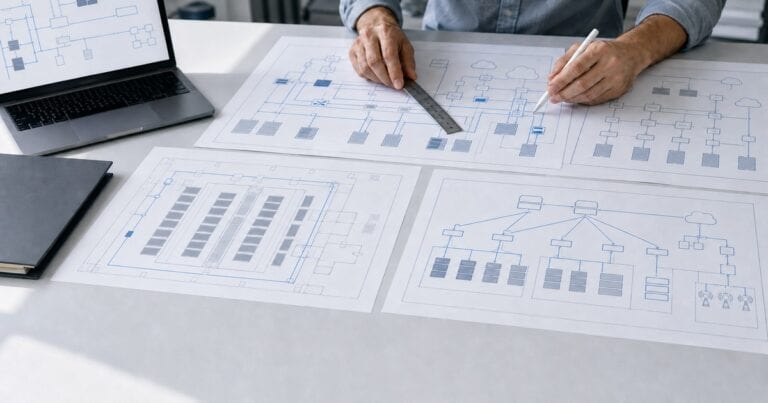
We prepare HLD, LLD and technical designs. The output is a set of documents any contractor can build the system from.
-
Specification and sign-off
We draw up the list of hardware, licences and the order of works. The output is a delivery plan ready for implementation.
These are steps 3–4 of the eight in the SafeCore approach: needs analysis and audit come before them, implementation, testing and support after. The full approach.
What is needed from the client — input data on sites, load and constraints, plus sign-off on the architecture at the checkpoint.
Result
What you receive as a result
The design package stays with you and does not tie you to the contractor who prepared it.
More on what the documentation contains — in technical and project documentation.
- The technical architecture of the solution
- A high-level design document (HLD)
- A low-level design document (LLD)
- Network interaction diagrams
- A specification of hardware and licences
- Decisions on redundancy and fault tolerance
Questions
Frequently asked questions about design
How long does infrastructure design take?
The duration depends on the number of sites, the classes of system involved and how complete the input data is. Timelines are fixed after the technical requirements have been gathered — that is the point at which the real scope becomes clear. You see an indicative schedule before work starts.
What does the cost of a design project depend on?
On the size of the environment, the number of systems, the depth of documentation and whether input data already exists. The calculation is made once the project boundaries have been agreed. The initial discussion of the task happens before that and commits you to nothing.
What is needed from our team?
Input data on sites, current systems, load and constraints — and someone who can confirm that data. After that, all we need from the client is sign-off on the architecture at the checkpoint.
Can we order the design on its own?
Yes. The design package is a standalone result, and it can be delivered by your own team or by another contractor. If SafeCore continues the work, the next step is implementation and system integration.
How does a design differ from a supplier’s proposal?
A supplier’s proposal describes the hardware they sell. A design describes your system as a whole: requirements, architecture, connections and redundancy — and the equipment list follows from it, not the other way round.
Next step
Ready to design infrastructure around your tasks?
Start with a conversation about the task — the scope and timelines are set after the preliminary analysis.

Full cycle
Related service areas
Design builds on consulting and leads into implementation and documentation.
-


IT and Cybersecurity Consulting
Development strategy, risk assessment, solution architecture
Read more IT and Cybersecurity Consulting -

Implementation and System Integration
Installation, configuration, integration, testing
Read more Implementation and System Integration -

Technical and Project Documentation
HLD, LLD, designs, instructions, procedures
Read more Technical and Project Documentation

